Public Health
Hot Food, Cold Truths: What’s Lurking Behind Your Delivery?
The Hidden Health Risk in Your Food Delivery: Plastic Containers and Hot Meals
October 5, 2025
By Health Parliament
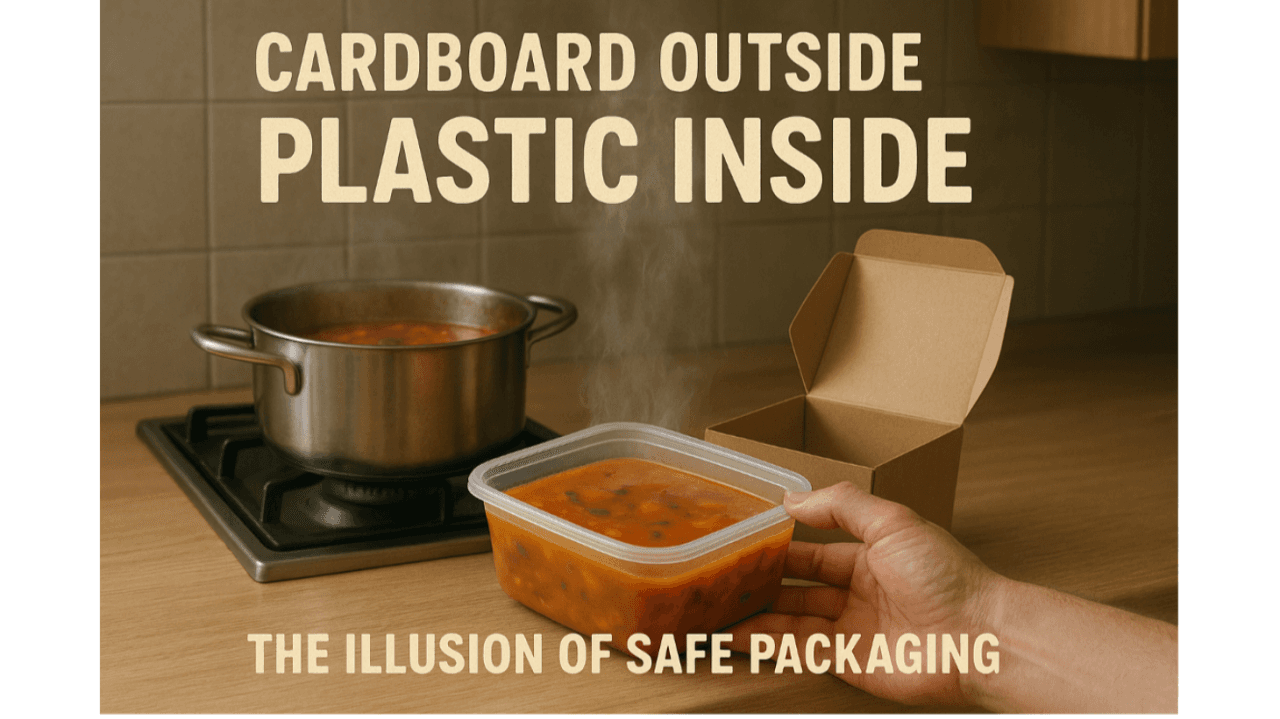
Imagine you’re cooking at home.
A pot of soup has just come off the stove, bubbling hot. Now ask yourself: Would you pour that into a plastic container, even one labeled “microwave safe”? Chances are, you’d hesitate. You’d probably think twice, or maybe a hundred times.
But when it comes to food businesses, especially in the race to scale and reach more customers, that same caution often goes missing.
Cardboard Outside, Plastic Inside - The Illusion of Safe Packaging
Many hot meals today are delivered in sleek cardboard boxes. But look closer - inside is often a plastic container. It’s a smart disguise, but a dangerous compromise. The food is still sitting in plastic, often poured in while piping hot.
And here’s the catch: many customers still believe they’re avoiding plastic, thanks to the outer packaging. It’s a delusion, but one with very real health consequences.
India is one of the largest food delivery markets in the world, with platforms processing tens of millions of orders every day. Yet there is no mandatory regulation requiring food delivery businesses to disclose the type of plastic used in their packaging, or to ensure that it is safe for contact with hot food. The consumer assumes the outer cardboard box means safety. The reality — a polypropylene or polystyrene container sitting underneath — is rarely disclosed.

Plastic + Heat = Health Hazard
Data doesn’t lie:
- A study published in the Royal Society of Chemistry journal Analyst in 2024 analyzed microplastic release from disposable plastic cups. When filled with water at 95°C for 15 minutes, polypropylene (PP) cups released an average of 1,340 particles per liter, and polystyrene (PS) cups released 980 particles per liter.
- Another review of 67 studies found that plastics commonly used in food packaging — polyethylene, polypropylene, and polycarbonate — can release phthalates and bisphenols into hot food, especially when the food is fatty or acidic.
- Researchers have identified over 100 non-intentionally added substances (NIAS) in plastic food containers, many of which migrate into food when exposed to heat.
NIAS are chemicals that enter plastic during the manufacturing, degradation, or recycling process — chemicals that were never intended to be there. Unlike intentional additives, NIAS are largely unregulated because they are not declared by manufacturers and are difficult to detect without advanced testing. Most consumers, and most food businesses, are entirely unaware of their presence.
Even so-called “food-grade” or “microwave-safe” plastics are not designed for boiling-hot temperatures, which is exactly the condition when hot food is packed directly after cooking.
What Needs to Change — A Policy Perspective
The science on plastic packaging and heat is not new. What is missing is the policy response.
Food safety regulations in India currently focus on the composition of food itself — additives, preservatives, contaminants. But the container the food travels in falls into a regulatory grey area. The Food Safety and Standards Authority of India (FSSAI) has issued guidelines on food contact materials, but enforcement — particularly in the unorganized food delivery segment — remains weak.
Health Parliament’s position on food safety policy is straightforward: food businesses have a responsibility to disclose packaging materials to consumers, and regulators have a responsibility to enforce minimum safety standards for hot food contact. A meal ordered from a delivery platform should carry the same packaging transparency standards as a product on a supermarket shelf.
Because what your food is served in, becomes part of what you serve your body.
Google Play Store: https://play.google.com/store/apps/details?id=com.dha.hp
Apple App Store: https://apps.apple.com/in/app/health-parliament/id1616801197
Authors

Health Parliament
Health Parliament is the world's foremost and fastest-growing healthcare think-tank. We believe in ground-level transformation through Real Work, Great Leaders, and Right Policies. Our work reaches the policymakers and has helped shape impactful public health interventions. We convene Thought Leaders and Industry experts through exclusive CEO roundtables, masterclasses, regional leadership development forums, webinars, and conferences. Health Parliament Membership is now open for healthcare professionals from India and 66 other countries.
Connect on LinkedInShare this article
Contact Us
+91 9911100774
Sign Up for the Latest News
Social Connect
Visitors:
Loading...