Public Health
Stop Blaming People for Poor Health: Most of It Isn’t in Their Control – Time to RESET Population Health Paradigm
Let’s put responsibility where the data say it belongs: on the policies and institutions with the power to shift the other 85–90%.
August 25, 2025
By Dr. Rajendra Pratap Gupta - Founder, Health Parliament
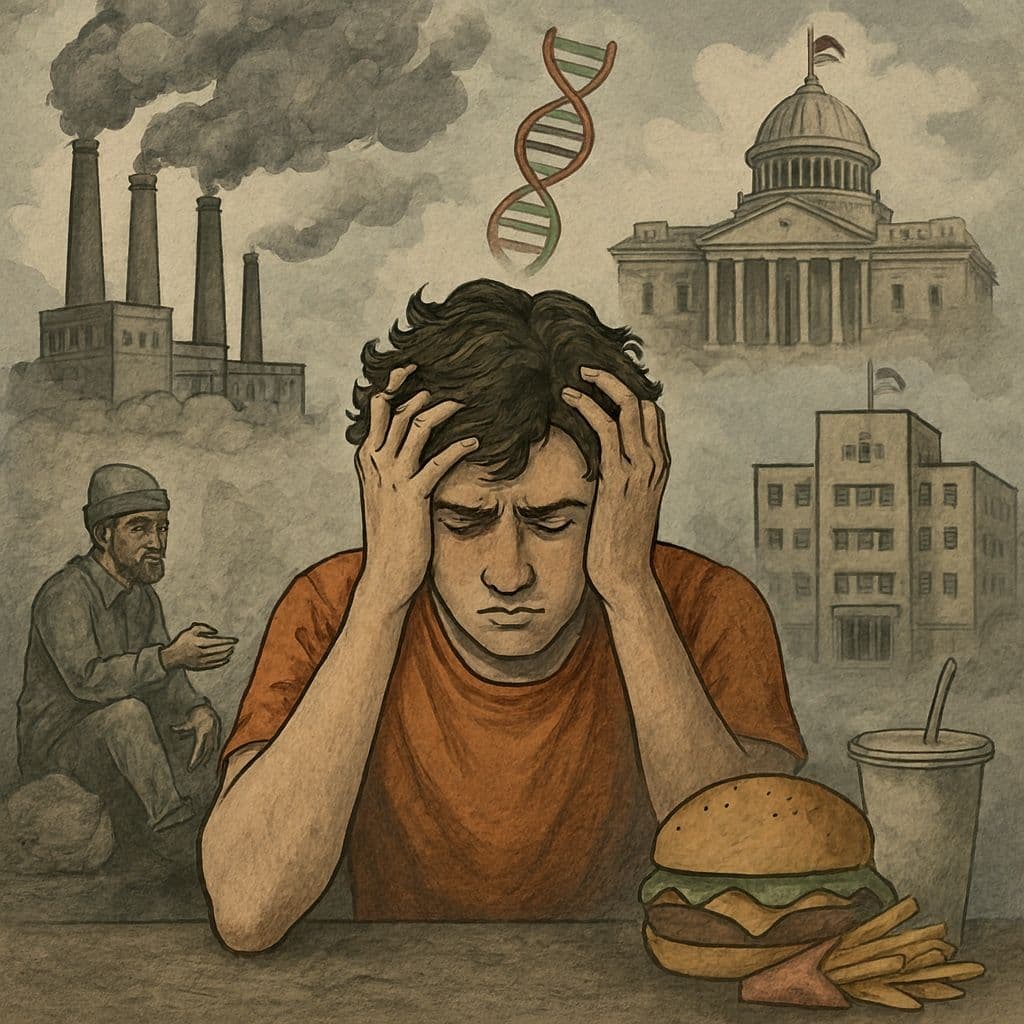
We often lecture individuals to “eat better,” “exercise,” or “take responsibility” for their health. But the weight of scientific evidence shows that most of what shapes health lies outside personal control—hard-wired biology, the places we live and work, and the policies that govern food, housing, and air. Here’s a data-driven reset.
Genetics (≈15–30%) — Inherited, not chosen
Large population studies estimate that genetics explains only a modest share of variation in lifespan and health—typically ~15–30%—and likely on the lower end when pedigree biases are corrected. You didn’t pick your parents; you can’t “will” your DNA away. [Khoury et al., 2022; Cutler et al., 2020]
Clinical Care (≈10–20%) — Necessary, but not the main driver
Across multiple analyses, medical care accounts for only 10–20% of modifiable health outcomes. Better access and quality matter, but they cannot overcome adverse social and environmental realities on their own. [McGinnis et al., 2002; Schroeder, 2007]
Social & Economic Conditions (≈40% of drivers)
The well-validated County Health Rankings model attributes about 40% of health to social and economic factors (education, income, community context). These “rules of daily life” are created by governments and markets, not by individuals. [County Health Rankings, 2023]
Physical Environment & Pollution (≥10% directly; far more indirectly)
The World Health Organization estimates that ~24% of all global deaths are attributable to environmental factors (unsafe air, water, and chemical exposures). Air pollution alone is linked to ~7 million premature deaths each year; household smoke from cooking fuels adds millions more. [WHO, 2023]
Food Systems & Ultra-processed Diets (~20%)
Multiple cohort syntheses show that higher intake of ultra-processed foods is associated with increased all-cause and cardiometabolic mortality. What’s on the shelf, how it’s priced, and how it’s marketed are shaped by corporate practices and regulation. [Srour et al., 2019; Monteiro et al., 2018]
So, what’s the individual’s share?
If we start with the National Academy of Medicine’s framing—only 10–20% of outcomes tied to clinical care and 80–90% to social, behavioral, and environmental determinants—and remember that “behaviors” are heavily constrained by where people live and what they can afford, a fair estimate of true personal agency over health settles around 10–15%. That is, the sliver of behaviors one can realistically control despite genetics, neighborhood safety, air quality, food availability, and work conditions. [National Academy of Medicine, 2017]
Reassigning responsibility
- Inheritance (genetics): ~20% — Not Controllable.
- Environment/pollution: ≥24% of deaths — Regulators & Polluters Accountable.
- Food systems: substantial risk: ~20% — Regulators & industry accountable.
- Clinical care: 10–20% — Health Systems Accountable.
- Individual agency: ~10–15% — Support, Don’t Shame.
With about 10% within the ambit of an individual’s control, why bash people!
Stop bashing people for “not taking care of themselves.” Extrinsic forces—genes you didn’t choose and environments you didn’t design—dominate health. If we want better outcomes, the levers are structural: clean air rules, safer food policies, decent housing and wages, and neighbourhoods that enable movement and connection. Individuals matter—habits still help—but systems matter more. Let’s put responsibility where the data say it belongs: on the policies and institutions with the power to shift the other 85–90%.
References
1. Khoury MJ, et al. (2022). Genetics and population health.
2. Cutler D, et al. (2020). The determinants of mortality.
3. McGinnis JM, et al. (2002). The case for more than health care.
4. Schroeder SA. (2007). We can do better—improving the health of the American people.
5. County Health Rankings (2023). Annual Report.
6. World Health Organization (2023). Environmental health estimates.
7. Srour B, et al. (2019). Ultra-processed food intake and mortality.
8. Monteiro CA, et al. (2018). The classification of foods according to processing.
9. National Academy of Medicine (2017). Vital Directions for Health and Health Care.
Authors

Dr. Rajendra Pratap Gupta
Founder, Health Parliament
Dr. Rajendra Pratap Gupta is a leading global voice in Health and is the key architect of the National Health Policy, the National Education Policy, and the Viksit Bharat Abhiyan. He has been globally recognized for his pioneering role in shaping the domain of digital health working with various multi-lateral bodies and governments. He chairs the United Nations’ Internet Governance Forum’s Dynamic Coalition on Digital Health, The Commonwealth AI Consortium for Capacity Building and the Global Chapters’ Initiative at the International Society for Telemedicine & eHealth, Basel, Switzerland.
Connect on LinkedInShare this article
Contact Us
+91 9911100774
Sign Up for the Latest News
Social Connect
Visitors:
Loading...